THE
KING OF CRACKERS
THE
KING OF CRACKERS 

"CHRISTMAS CRACKER HISTORY
|
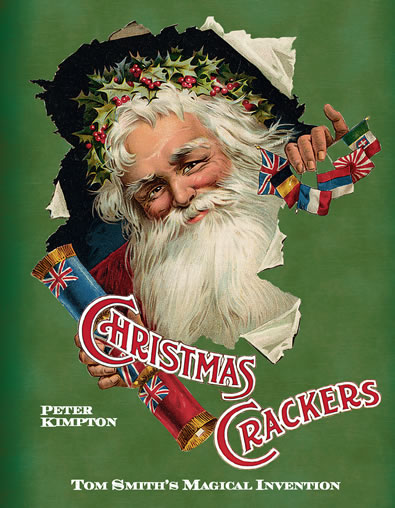 A beautifully produced book containing many stunning Cracker associated images from the 19th - 20th centuries. |
|
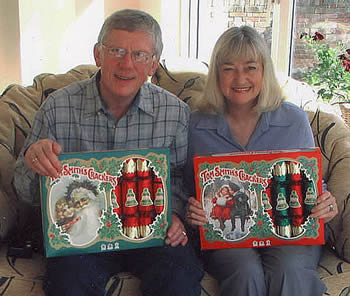
Author Peter Kimpton (above) with partner Rose Tibbles displaying a pair of Victorian style cracker boxes which he designed whilst working with the Tom Smith Cracker company when it was based in Norwich, England where it operated for over forty years. Peter has contributed to numerous newspaper, magazine and web articles (including “The Field” magazine) both in the UK and America - relating to the history of the Christmas cracker and has appeared on or contributed to various presentations on German TV, Channel 1 TV Russia, BBC Victorian Farm, BBC Countryfile, BBC Breakfast, BBC Radio Ulster, BBC Radio Stoke, Mustard TV (Mike Hicks Christmas Collectibles), RTE Ireland-Irish National Radio (See details on page 5 Re: my full Lecture Service). CHRISTMAS IN THE TRENCHES: Early in 2009, my researches led me to discover that during the Christmas period of the 1st World War – January 1915 to be exact - an unknown English soldier wrote home to his loved ones back in the little Cumbrian town of Maryport. In his letter, subsequently published in the Whitehaven News, he relates how one of his pals who shared his "Buggy hut" with him had received a parcel - amongst the contents of which was a box of Tom Smith's crackers which, during the unofficial Christmas truce period of just a few days earlier where he was based, they and four others pulled with great merriment. One can perhaps imagine the almost unreal scene and ponder for a moment as to whether those particular "Tommies" ever escaped the carnage and made it back in one piece to pull crackers once again in good old "Blighty". Sadly, the odds it has to be said were not high. 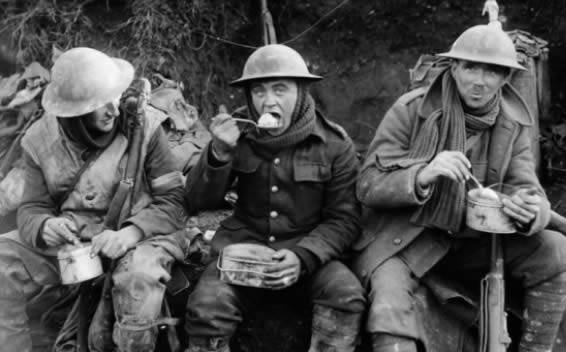 |
||
But times move on and certainly, here in the 21st century, with the great majority of all crackers on offer being cheaply manufactured in China (funnily enough a country that, with only roughly 1% being Christian does not even officially celebrate Christmas), the great heyday of the Christmas cracker from around 1880 to 1920 has long since passed. But in those far off days of over a century ago when crackers really were crackers, the great family run company of Tom Smith's, based in Wilson St. in London, had spread its wings to all corners of not only the British Empire but across the world in general - testament if testament were needed to the vision and flair of the cracker's accepted inventor Thomas Smith during the Victorian period. Having said that, even in his short lifetime (and indeed following his untimely death), various members of the Victorian press still referred to him as – “The King of Crackers” – such was his enduring reputation. *The following details regarding the origins of cracker snaps kindly supplied by Australian chemist Barry Sturman in 2008 from his research for the three-volume “Encyclopedia Dictionary of Pyrotechnics and Related Subjects” which was published in 2012 by Journal of Pyrotechnics Inc. |
||
In his book "A History of Fireworks", Alan St Hill Brock
(1886 - 1956 ) of Brocks Fireworks, referred to an old book "The
Art of Making Fireworks by Plain and Easy Rules" by T. Angelo.
Brock says this was published "c.1816", and he wrote of
Angelo:- |
||